Most e-signature platforms answer one question well: did this person agree to sign? They capture intent, log a timestamp, and produce an audit certificate. But they rarely answer the question recipients actually ask months later — is this exact document genuine and unaltered, and how would I prove it without trusting the platform that made it?
This article defines a verifiable e-signature for 2026: the legal signing event, the tamper-evident final record, and independent recipient verification. It explains why so many platforms stop at signing, and what the legal frameworks — ESIGN, UETA, and eIDAS — do and don't guarantee.
What is a verifiable e-signature?
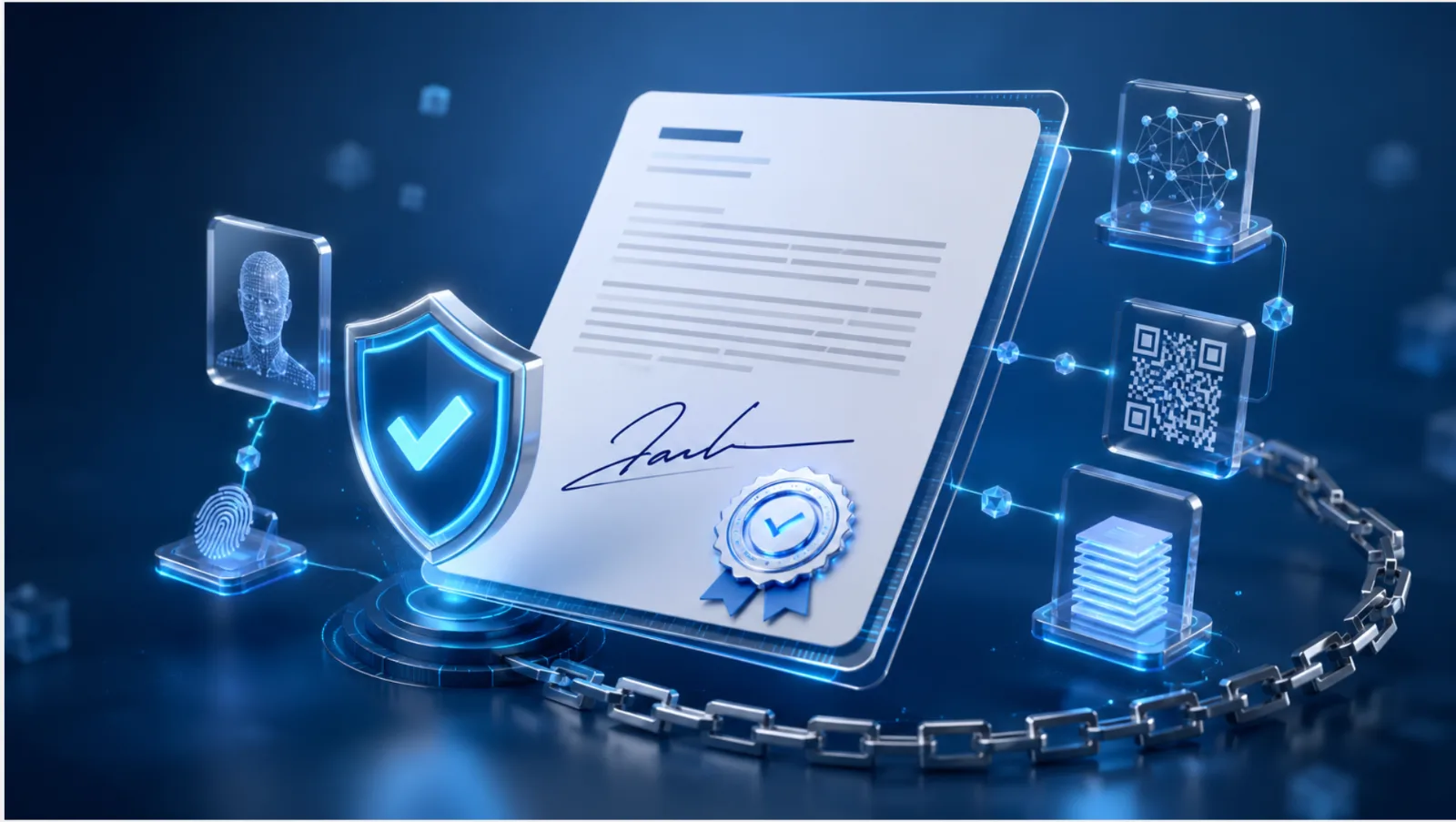
A verifiable e-signature is one that satisfies three requirements at once: a legally valid signing event, a tamper-evident final record, and independent recipient verification. The signing event captures intent and consent — the act the law recognizes. The tamper-evident record cryptographically proves the finished document has not changed since it was signed. Independent recipient verification means any third party — a landlord, lender, employer, or regulator — can confirm the document is authentic without logging into the signing platform or trusting the file at face value. A signature that only proves someone clicked "sign" meets the first requirement and fails the other two. That gap matters because a signed PDF can still be exported, altered, and re-shared, and the original recipient has no built-in way to detect it. True verifiability moves the proof out of the file and onto infrastructure the recipient can check directly. The pillar guide on verifying document authenticity covers how these layers fit together.
Why do most e-signature platforms stop at signing?
Most platforms stop at the signing event because that is what the e-signature category was built to do: capture consent and produce a legally admissible audit trail. DocuSign, Adobe Acrobat Sign, and similar tools excel at workflow — routing, reminders, and a completion certificate — but their job effectively ends when the document is signed and downloaded. After that, the signed PDF travels as a static file, and there is usually no issuer-hosted way for a downstream recipient to re-confirm it is the genuine, unaltered version. This made sense when documents were hard to convincingly forge. It no longer does: digital document forgeries rose 244% year over year in 2024 and now make up 57% of all document fraud (Entrust 2025 Identity Fraud Report). The missing piece is a verification layer the recipient controls, which is why teams increasingly pair signing with QR-backed verification.
What do ESIGN, UETA, and eIDAS actually require?
These frameworks establish that electronic signatures are legally enforceable, but they govern the signing act, not after-the-fact recipient verification. In the US, the federal ESIGN Act (2000) and state-level UETA make electronic signatures enforceable when intent, consent, association with the record, and retention are present, though some documents like certain wills and court filings may still need wet signatures. In the EU, eIDAS defines three tiers — simple (SES), advanced (AdES), and qualified (QES), with QES holding the legal equivalence of a handwritten signature — and eIDAS 2.0 (Regulation 2024/1183) introduced the EU Digital Identity Wallet. Crucially, none of these laws require that a recipient be able to independently re-verify the finished document later. They make a signature valid; they do not make a document self-provable. That second guarantee is what a verifiable e-signature adds. See ESIGN Act vs UETA and eIDAS explained for detail.
How do signing-only and fully verifiable e-signatures compare?
The difference is whether proof of the document survives after it leaves the platform and reaches a third party who doesn't trust the file on sight.
| Capability | Signing-only platform | Verifiable e-signature |
|---|
| Captures intent and consent | Yes | Yes |
|---|
| Legally enforceable (ESIGN/UETA/eIDAS) | Yes | Yes |
|---|
| Tamper-evident final record | Sometimes | Yes |
|---|
| Recipient verifies without platform login | No | Yes |
|---|
| Stays checkable years after signing | Limited | Yes |
|---|
| Survives export and re-sharing as a static file | No proof | Yes, via issuer proof page |
|---|
A signing-only tool produces a valid signature; a verifiable e-signature produces a document a stranger can independently confirm. For HR, that distinction is the gap between a signed offer letter and a tamper-proof offer letter an employee can prove is real.
How does VerifyDoc.ai deliver a verifiable e-signature?
VerifyDoc.ai adds the two layers most platforms skip: a tamper-evident final record and independent recipient verification. After a document is signed, it attaches QR-backed verification, a hosted issuer-controlled proof page, a certificate of authenticity, cryptographic hashing, and an audit trail, so any recipient can confirm the finished document is genuine and unaltered with no login and no app. Because the proof lives on the issuer's infrastructure rather than inside the PDF, exporting or re-sharing the file cannot strip or fake the verification — a forged copy simply fails the check. This complements signing tools rather than replacing the legal act: the signature establishes enforceability under ESIGN, UETA, and eIDAS, while VerifyDoc.ai makes the result provable to third parties. Explore the approach on the e-signatures product page or the broader verify document authenticity playbook.