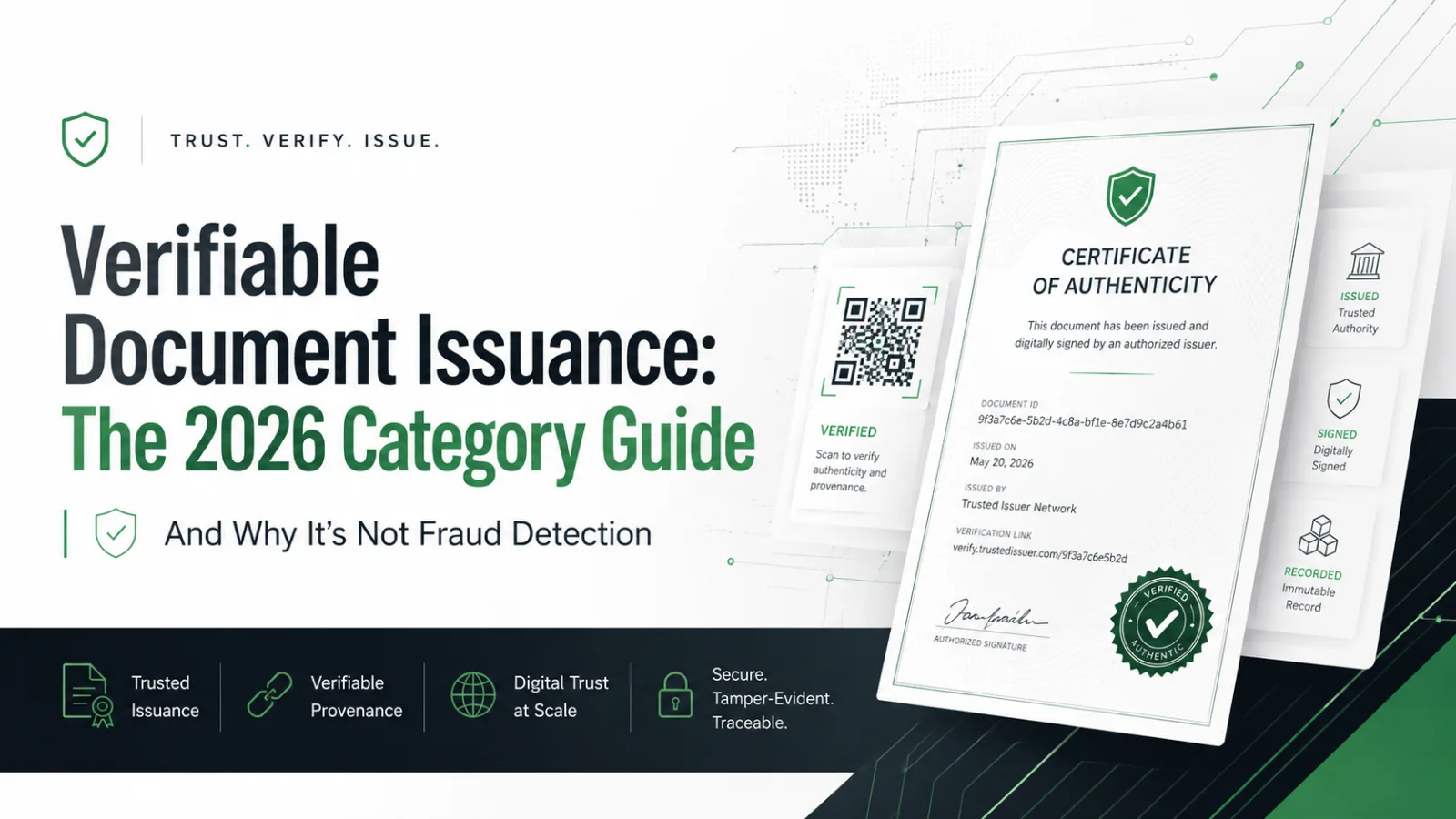
Two very different strategies promise to fight document fraud. One inspects documents after they appear and guesses whether they are fake. The other proves documents are real the moment they are created, so there is nothing to guess about later. They are easy to confuse and they are not the same thing.
This guide defines verifiable document issuance as a category, explains how it works, and contrasts it directly with fraud detection so you can tell which problem each actually solves.
What is verifiable document issuance?
Verifiable document issuance is a category of technology that proves a document is authentic at the point of creation by binding it to an issuer-controlled record that anyone can later verify. When the issuer produces the document, the platform computes a cryptographic hash of the authentic version, attaches a QR code or link, and publishes a hosted proof page on the issuer's own infrastructure. From then on, any recipient can confirm the document is genuine and unaltered without contacting the issuer. The key word is issuance: authenticity is established upstream, at the source, rather than asserted by the file itself. This is the model VerifyDoc.ai uses to attach verification, a certificate of authenticity, and an audit trail to documents as they are issued or signed.
How is verifiable issuance different from fraud detection?
Verifiable document issuance proves authenticity at the source; fraud detection tries to spot fakes after they are already circulating. Detection tools — forensic image analysis, metadata checks, AI classifiers — examine a document you received and estimate how likely it is to be forged. They are probabilistic, they produce false positives and negatives, and they are locked in an arms race with generative tools that keep improving. Issuance flips the problem: if a document carries a valid link to the genuine issuer's record, it is provably real; if it does not, it simply is not verified. There is no guessing. Detection remains useful for documents you did not issue and have no record for, but for anything you issue yourself, proving it upstream is both cheaper and more certain than detecting fakes downstream.
Why is upstream issuance more reliable than downstream detection in 2026?
Upstream issuance is more reliable because the volume and quality of forgeries have outpaced what after-the-fact detection can catch. Digital document forgeries rose 244% year over year in 2024 and became 57% of all document fraud (Entrust 2025 Identity Fraud Report), and deepfake fraud attempts climbed 2,137% over three years (Signicat, 2025). When AI can manufacture a flawless-looking document in seconds, a detector that grades appearance is always one model behind. A proof anchored to the issuer at creation does not degrade as forgery tools improve, because it does not rely on the file looking suspicious — it relies on the genuine record existing on infrastructure a forger cannot control.
How do issuance and detection compare side by side?
The two approaches differ in when they act, what they rely on, and how certain the answer is.
| Dimension | Verifiable document issuance | Fraud detection |
|---|
| When it acts | At creation (the source) | After the document circulates |
|---|
| What it relies on | Issuer-controlled record + cryptographic hash | Forensic/AI analysis of the file |
|---|
| Type of answer | Provable: verified or not | Probabilistic: likely real or fake |
|---|
| Keeps up as AI improves? | Yes, independent of file appearance | Struggles, an ongoing arms race |
|---|
| Best for | Documents you issue | Documents you received, with no record |
|---|
The two are complementary: see the pillar on how to verify document authenticity and our guide to AI document fraud red flags for the detection side.
Where does VerifyDoc.ai fit in the issuance category?
VerifyDoc.ai sits squarely in the verifiable document issuance category: it makes documents provable at the moment they are issued or signed, rather than scoring them for forgery afterward. It attaches QR-backed verification, an issuer-controlled proof page, a certificate of authenticity, cryptographic hashing, and a tamper-evident audit trail — no recipient login or app required. This complements e-signature and automation tools by proving the finished document, not just capturing a signature; see how that plays out in what a verifiable e-signature really means. For teams issuing bank statements, certificates, offer letters, or permits at scale, issuance turns authenticity from a downstream investigation into a built-in property of every document.