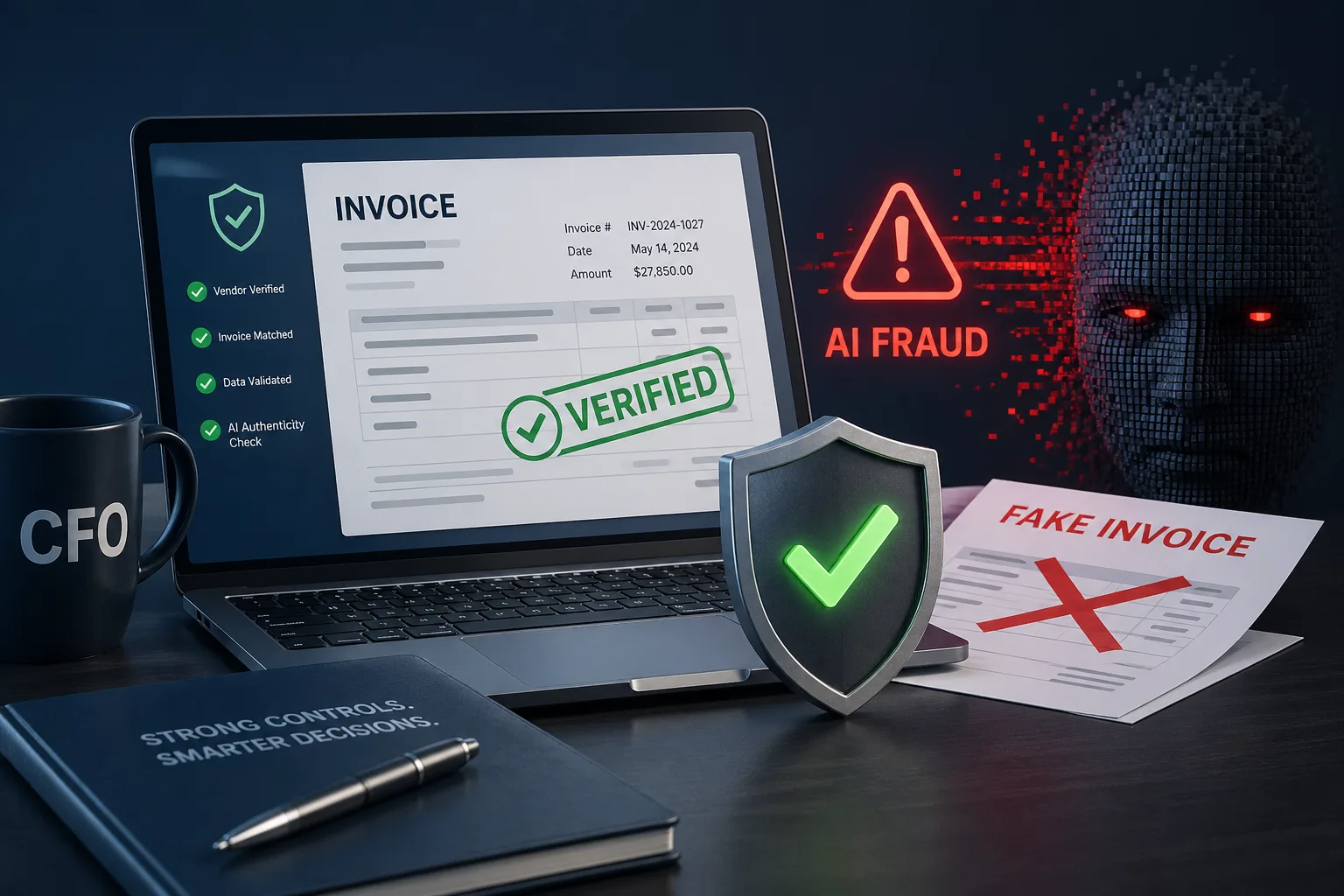
Invoices are where document fraud turns directly into wired money. A finance team approves a plausible invoice or a vendor's banking-change request, and the payment is gone. AI has sharpened the threat: forged invoices and spoofed vendor emails now look indistinguishable from the real thing.
This guide gives CFOs and controllers a practical view of how invoice fraud works in 2026, why approval workflows that rely on appearance fail, and how verifiable invoices plus out-of-band confirmation close the gap. It is written for finance leaders responsible for accounts payable and payment controls.
How big is the invoice and BEC fraud problem in 2026?
Invoice fraud is one of the costliest cyber-enabled crimes, because it converts a forged document into an immediate wire. Business email compromise — which prominently includes bogus-invoice and vendor-impersonation schemes — drove $2.77 billion in losses across 21,442 complaints in 2024, with nearly $8.5 billion lost over 2022-2024 (FBI IC3 2024 Internet Crime Report). Overall U.S. cybercrime losses hit a record $16.6 billion in 2024, up 33% year over year (FBI IC3 2024 Internet Crime Report). The document side is getting easier to fake too: digital document forgeries rose 244% in 2024 and became 57% of all document fraud (Entrust 2025 Identity Fraud Report). For a CFO, the takeaway is that fake invoices are a primary loss channel, not an edge case, and approval controls must assume forgeries will reach the inbox.
Why do AI-forged invoices pass standard approval workflows?
AI-forged invoices pass standard approval workflows because those workflows check whether an invoice looks legitimate and matches a PO, not whether it was genuinely issued by the vendor. AI produces invoices with correct totals and tax math, accurate vendor branding, realistic line items, and plausible invoice numbers, so they clear visual and three-way-match review. The most damaging variant pairs a clean invoice with a spoofed or compromised vendor email requesting a change of banking details — the document and the request both look authentic. The structural flaw is the same one that undermines visual inspection everywhere: the absence of obvious tells is not proof of authenticity. For the broader pattern, see the red flags of an AI-generated fake document. The fix is to verify the issuer and the payment instruction independently, not to inspect the invoice harder.
What controls actually stop fake invoices?
The controls that work tie the invoice and the payment instruction back to the vendor through a channel the fraudster does not control. The table contrasts common controls by what they actually catch.
| Control | Stops a look-alike forgery? | Stops a banking-change scam? | Recipient effort |
|---|
| Visual review of the invoice | No | No | Low |
|---|
| Three-way match (PO/receipt/invoice) | Sometimes | No | Medium |
|---|
| Out-of-band callback to a known vendor contact | Yes | Yes | Medium |
|---|
| Verifiable invoice (issuer proof page) | Yes | Partly | Low |
|---|
| Verifiable invoice + out-of-band banking confirmation | Yes | Yes | Medium |
|---|
The pattern: a verifiable invoice confirms the document is genuine and unaltered, and an out-of-band callback confirms the payment instruction. Together they close both gaps. A QR-backed proof page is what makes the document side instant and scalable.
What is a verifiable invoice, and how does it help finance teams?
A verifiable invoice is an invoice the issuer attaches proof to, so the recipient can confirm it is genuine and unaltered without contacting anyone. With VerifyDoc.ai, each invoice carries QR-backed verification, a hosted issuer-controlled proof page, a certificate of authenticity, and cryptographic hashing. An accounts-payable reviewer scans the code and sees an instant authentic-or-not result — no app, no login — and because the proof lives on the issuer's infrastructure, a forged copy cannot fabricate a valid result. For finance teams this turns invoice authenticity from a judgment call into a deterministic check, and it works in both directions: a company can issue verifiable invoices so its own customers are not defrauded by lookalikes, and can prefer verifiable invoices from vendors. It does not by itself confirm a banking-detail change, so pair it with an out-of-band callback for payment-instruction changes. For the full method, see the pillar guide on verifying document authenticity.
How should a CFO roll out verifiable invoices?
Start where the loss exposure is highest and the change is cheapest, then expand. First, set a payment-control rule that any change to vendor banking details requires out-of-band confirmation to a previously known contact, regardless of how authentic the request looks — this alone blocks the most expensive BEC variant. Second, begin issuing your own invoices as verifiable invoices so customers can confirm them and lookalike invoices in your name fail. Third, make verifiable invoices a preference in vendor onboarding and flag unverifiable high-value invoices for extra scrutiny. Fourth, train accounts payable to treat an invoice they cannot verify as unverified, not payable. This sequencing front-loads the controls that stop the largest losses — BEC drove $2.77 billion in 2024 (FBI IC3 2024 Internet Crime Report) — while building toward document-level verification across the payables process. Finance teams that also underwrite or accept income documents will find the same issuer-verification principle in detecting AI-generated bank statements.