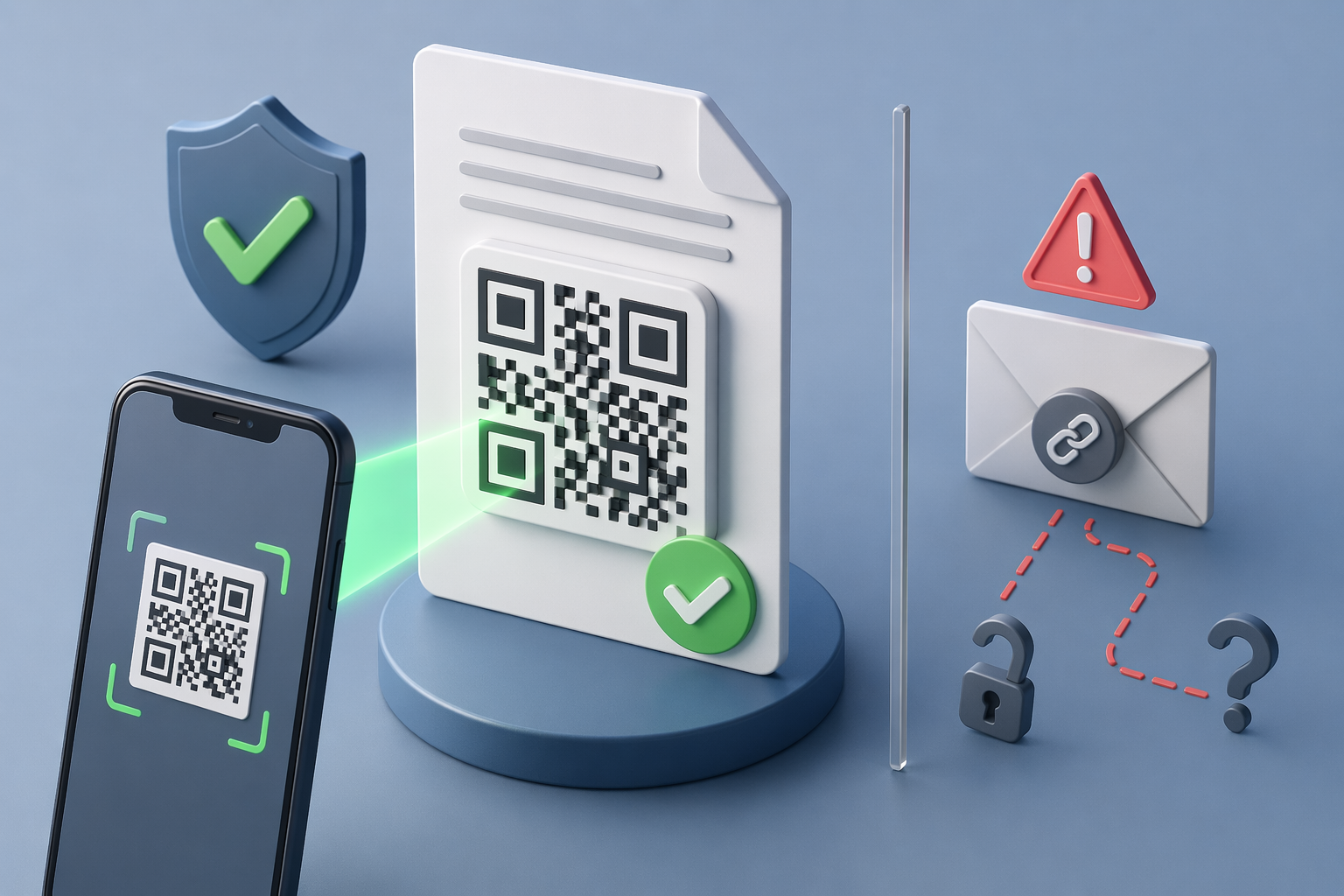
There are four common ways to prove a document is real: call or email the issuer, click a link they emailed you, verify against a blockchain, or scan an issuer-controlled QR code. They are not equal.
This comparison scores each method on the four things that actually matter to a recipient and an issuer — speed, self-serve, tamper detection, and cost or complexity — and explains why QR plus a registry is the default for most teams.
How do the four document verification methods compare?
On the four factors that matter most, an issuer-controlled QR code leads for everyday document verification. Manual verification is thorough but slow and costly; email links are convenient but spoofable; blockchain is tamper-resistant but operationally heavy; QR plus a hosted registry is fast, self-serve, and tamper-evident at low cost.
| Method | Speed | Recipient self-serve | Tamper detection | Cost / complexity |
|---|
| Manual (call / email issuer) | Hours to days | No | Weak, human judgement | High per-check labour |
|---|
| Email verification link | Seconds | Yes | Weak (link can be faked) | Low |
|---|
| Blockchain anchoring | Seconds to minutes | Sometimes (needs explorer) | Strong | High (infra + expertise) |
|---|
| Issuer-controlled QR + registry | Seconds | Yes | Strong (vs issuer record) | Low |
|---|
Why is manual verification the slowest and most expensive option?
Manual verification is the slowest and most expensive method because it puts a human in the loop for every single check. Confirming employment or income manually typically costs $60 to $125 or more per request and takes one to five business days, while automated databases clear only about 30 to 35% of requests (industry pricing via Truework). For an issuer fielding hundreds of verification calls, that labour adds up fast; for a recipient, it means waiting days for a yes-or-no answer. Manual checks also depend on reaching the right person and on their judgement, which AI-generated forgeries are increasingly good at fooling. It remains a fallback when nothing better exists, but it does not scale and it is the weakest link in any high-volume verification process.
Why are email verification links easy to spoof?
Email verification links are easy to spoof because the trust signal — the link and the sender — is exactly what an attacker can fake. A forger can send a "verify your document here" email from a look-alike address pointing to a convincing but fraudulent page, and the recipient has no independent way to tell it apart from the real thing. Email-based fraud is already the costliest category of cybercrime: Business Email Compromise drove $2.77 billion in reported losses across 21,442 complaints in 2024 alone (FBI IC3 2024 Report). A link in an inbox carries no inherent proof of origin. By contrast, a QR code printed on the document resolves to the issuer's own domain, which a forger cannot control — shifting the trust anchor from a message to infrastructure.
When is blockchain verification actually worth it?
Blockchain is worth it only in specific cross-organization trust models where no single party should own the record, and it is overkill for most document verification. It does provide strong tamper resistance, but it adds real cost and complexity: blockchain infrastructure, key management, gas or hosting fees, specialist expertise, and a recipient experience that often requires an explorer tool rather than a simple scan. For the core job — letting a recipient confirm a document is authentic and unaltered — an issuer-controlled QR code with cryptographic hashing and an audit trail delivers the same tamper detection without the overhead. Reserve blockchain for consortia or regulatory settings that genuinely need decentralized, multi-party trust. For everything else, the registry model is simpler and just as defensible. Our QR vs blockchain vs email links deep dive covers the mechanics.
Which method should most teams choose?
Most teams should choose an issuer-controlled QR code backed by a hosted registry, because it wins on every practical axis at once: seconds to verify, no app or login for the recipient, strong tamper detection against the issuer's record, and low cost to operate. That is the model VerifyDoc.ai provides — QR-backed verification, a hosted proof page, a certificate of authenticity, cryptographic hashing, and an audit trail — so a recipient can confirm a document without contacting anyone. Keep manual verification only as a fallback, avoid email links as a primary trust signal, and reach for blockchain only when a specific multi-party requirement demands it. For the full framework, see our pillar on how to verify document authenticity.