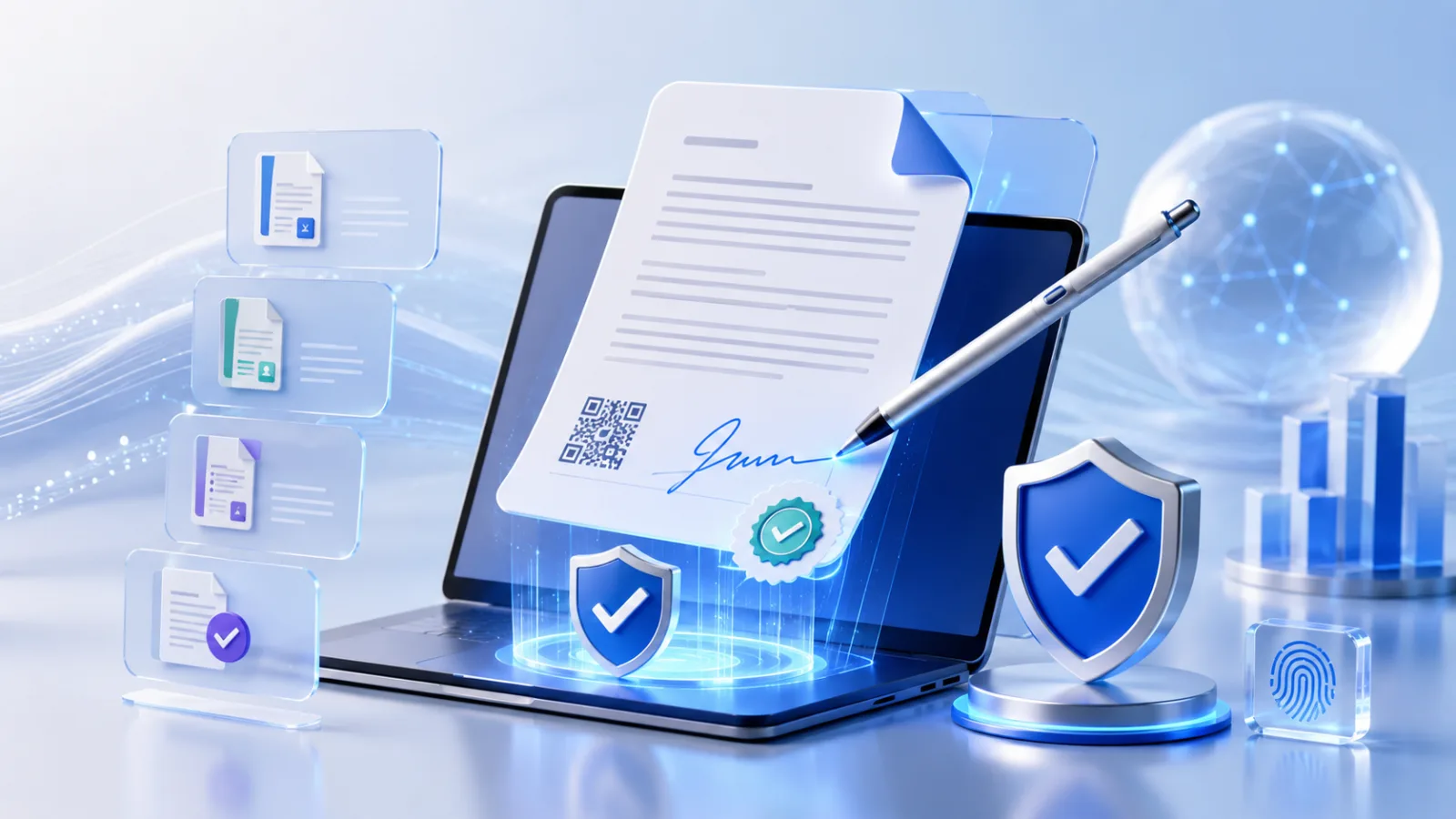
Most e-signature buying guides rank tools by signing speed, templates, and integrations. Those matter — but they all stop at the moment of signing. In 2026, the harder problem is what happens after: can the person who receives the finished document actually prove it is real and unaltered?
This guide reframes the buying criteria around post-signature verification, gives you a capability checklist to score any tool, and explains where VerifyDoc.ai fits alongside the e-signature platforms you may already use.
Why should post-signature verification be the top buying criterion in 2026?
Because the biggest risk has shifted from capturing a signature to proving the finished document is genuine. AI has made convincing document forgery cheap and fast: digital document forgeries rose 244% year over year in 2024 and, for the first time, overtook physical counterfeits to make up 57% of all document fraud (Entrust 2025 Identity Fraud Report). A signed PDF can still be screenshotted, edited, and re-shared, and most recipients have no practical way to validate it. So the question that should drive your shortlist is not "how fast can we sign?" but "after we sign, can a counterparty, regulator, or customer confirm this exact document is authentic in seconds?" That single criterion separates tools that capture intent from tools that produce a provable record.
What criteria should you use to evaluate e-signature software with verification?
Score each tool on the capabilities that determine whether the finished document is provable, not just signed. The checklist below turns "built-in verification" into concrete, testable criteria.
| Evaluation criterion | What to look for |
|---|
| Tamper-evident integrity | Cryptographic hash detects any post-signing change |
|---|
| Recipient verification | Anyone can verify with no login and no app |
|---|
| Issuer-controlled proof page | Proof lives on the issuer's domain, not inside the file |
|---|
| Certificate of authenticity | A standalone record confirming the document is genuine |
|---|
| Audit trail | Logs of signing, viewing, and verification events |
|---|
| Longevity | Document stays verifiable years after issuance |
|---|
| QR / scannable verification | Works in print and PDF, scannable from any phone |
|---|
A tool that checks the top three rows solves the post-signature gap most signing platforms leave open. Treat the rest as differentiators.
How do e-signature tools and verification-first platforms differ?
E-signature platforms like DocuSign, Adobe Acrobat Sign, and PandaDoc are excellent at the signing workflow — routing, templates, reminders, and audit certificates that document the signing event. Where they typically stop short is independent, self-serve recipient verification of the finished document: confirming a signature certificate usually needs the right software and know-how, and a recipient rarely has either. A verification-first platform inverts the emphasis. It assumes the document will travel — printed, forwarded, downloaded — and makes the proof reachable by anyone via a QR code resolving to an issuer-controlled page. The two are complementary: use a signing tool to capture intent efficiently, and add a verification layer so the result is provable afterward. See our deeper look at what a verifiable e-signature actually is.
How is verifying a signed document different from validating a signature?
Validating a signature confirms who signed a file at a point in time; verifying a signed document confirms that a specific copy is authentic and unaltered, instantly, by any recipient. The distinction matters operationally. A landlord checking a signed lease, an employer confirming an offer letter, or a regulator reviewing a permit does not want to install software, locate a certificate authority, and interpret a validation result — they want a scan that resolves to the issuer's genuine record. That is why the electronic vs digital signature distinction underpins this whole category: the legal act and the cryptographic technology both still leave the recipient-verification gap open. Built-in verification closes it by making the proof self-serve. Read the pillar guide on how to verify document authenticity for the full framework.
Where does VerifyDoc.ai fit among e-signature tools?
VerifyDoc.ai is the verification layer that makes a finished, signed document provable — designed to complement signing tools rather than replace them. It attaches QR-backed verification, cryptographic hashing, a hosted issuer-controlled proof page, and a certificate of authenticity, so any recipient can confirm a document is authentic and unaltered with no login and no app, years after it was issued. If your signing platform handles routing and intent capture well but leaves recipients unable to prove the result, VerifyDoc.ai fills that exact gap — and it works across PDF and print workflows where signature validators fall down. Explore the e-signatures product page and the verifiable e-signature definition to map it to your stack.