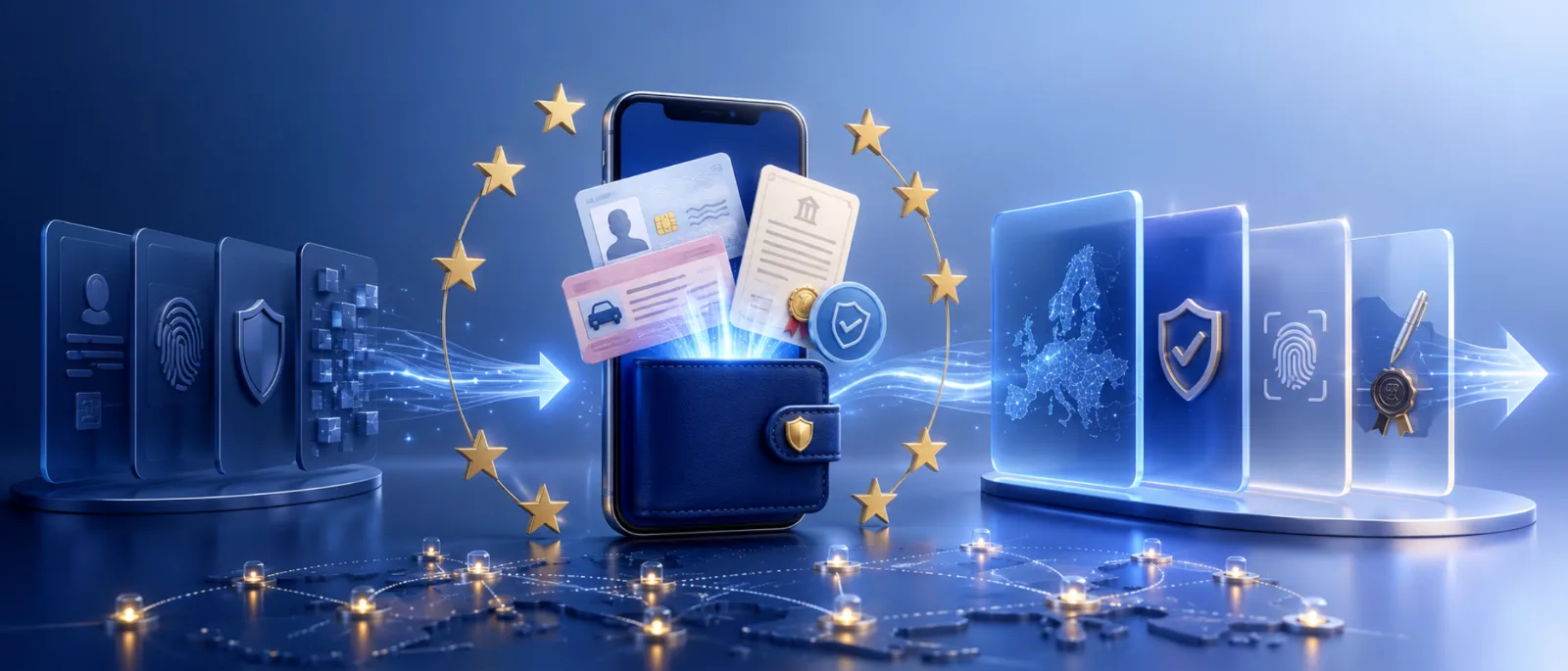
The original eIDAS regulation (910/2014) made electronic signatures and trust services legally recognised across the EU. eIDAS 2.0 — formally Regulation (EU) 2024/1183 — goes further, putting a user-controlled digital identity wallet at the centre of how Europeans prove who they are and what they are entitled to.
This guide covers what actually changed between 2024 and 2026: the legal milestones, the EUDI Wallet rollout, the new trust services, and what it means for organisations that issue or verify documents and credentials.
What is eIDAS 2.0 and when did it take effect?
eIDAS 2.0 is Regulation (EU) 2024/1183, which amends the original eIDAS framework and was published on 30 April 2024, entering into force on 20 May 2024 (European Commission, EU Digital Identity Regulation). Its headline change is the EU Digital Identity (EUDI) Wallet — a user-held app for storing and presenting verified identity data and credentials. The original three signature tiers from the first article in this series, eIDAS explained, remain intact; eIDAS 2.0 builds a new identity and attestation layer on top of them. It also introduces verifiable credentials, selective disclosure, and a common Architecture Reference Framework (ARF) so that a wallet issued in one member state works across all others.
What is the EUDI Wallet and what does it do?
The EU Digital Identity (EUDI) Wallet is a member-state-provided app that lets citizens and residents store, manage, and selectively share verified identity attributes and credentials. Instead of handing over a full ID document, a user can disclose only the attribute a service needs — for example, proving they are over 18 without revealing their date of birth — using selective disclosure built on verifiable credentials. The wallet is designed for cross-border use: under the Architecture Reference Framework, a wallet issued by one member state is accepted across all 27. It can hold government identity, but also professional qualifications, diplomas, and other attestations, turning the wallet into a portable, privacy-preserving credential holder rather than just a login tool.
What changed between 2024 and 2026?
The shift from 2024 to 2026 moved eIDAS 2.0 from text to rollout. The regulation entered force in May 2024, the first implementing acts were adopted in early December 2024, and further rounds through 2025 covered relying parties, trust services, and attestations.
| Milestone | Timing | What it means |
|---|
| Regulation 2024/1183 enters force | May 2024 | Legal basis for the EUDI Wallet established |
|---|
| First implementing acts adopted | December 2024 | Technical rules for wallets begin |
|---|
| Member states must offer a wallet | By December 2026 | All 27 states provide citizens a wallet |
|---|
| Large platforms and regulated sectors must accept it | From late 2027 | Banks, telecoms, big platforms onboard |
|---|
What new trust services did eIDAS 2.0 add?
eIDAS 2.0 expands trust services beyond signatures, seals, and timestamps to include Qualified Electronic Attestations of Attributes (QEAAs). A QEAA lets a trusted provider vouch for a specific attribute — a professional licence, a corporate role, an academic qualification — so a relying party can verify it without contacting the original issuer. This matters for document and credential verification: it formalises, under EU law, the idea that a verifiable attribute can travel with a person and be checked instantly. Obligated private-sector organisations, including banking, healthcare, telecoms, and very large online platforms, will be required to accept the EUDI Wallet as an authentication method, broadening where these attestations are used. The original signature tiers and qualified trust service provider model carry over from eIDAS explained.
How does eIDAS 2.0 relate to document verification?
eIDAS 2.0 strengthens identity and attribute verification, but it does not replace the need to prove a specific finished document is authentic and unaltered after issuance. A wallet can confirm who a person is or that they hold a credential; it does not, by itself, give a recipient holding a PDF certificate or statement a way to confirm that exact file matches the issuer's record. VerifyDoc.ai addresses that gap with QR-backed verification and a hosted, issuer-controlled proof page that any recipient can check in seconds — complementing wallet-based identity rather than competing with it. For the broader picture, see our pillar guide on how to verify document authenticity and the guide to issuing a certificate of authenticity.